
Best Cron Job Monitoring Tools for Small Teams in 2026
A missed cron job can stay quiet until a backup is missing, a report is late, or a customer spots stale data. The best cron job monitoring for small teams catches that gap without adding another full-time operations project. Here are six strong options, with Watchgoose first for teams that want focused checks, simple setup, and low ongoing work.
This guide is published by Watchgoose. We rank our own product first for the small-team use case described here and make the tradeoffs clear so you can compare it with broader alternatives. The images are original Watchgoose editorial diagrams, not vendor-interface screenshots or endorsements.
Table of contents
- Watchgoose: Straightforward monitoring for jobs, backups, and scripts
- Healthchecks.io: A simple heartbeat monitor with a generous no-cost tier
- Cronitor: Schedule-aware monitoring for complex cron workloads
- Hyperping: Cron monitoring with on-call and status page features
- Better Stack: Monitoring, logs, and incident response in one platform
- UptimeRobot: A familiar choice for freelancers and small teams
- Comparison table: Which cron monitoring tool fits your team?
- What to look for in cron job monitoring for a small team
- Frequently asked questions
- Conclusion
1. Watchgoose: Straightforward monitoring for jobs, backups, and scripts
Watchgoose is a focused monitor for cron jobs, backups, queues, and scripts. It fits small teams that want an alert when a task fails or misses its expected success signal, without installing monitoring infrastructure.
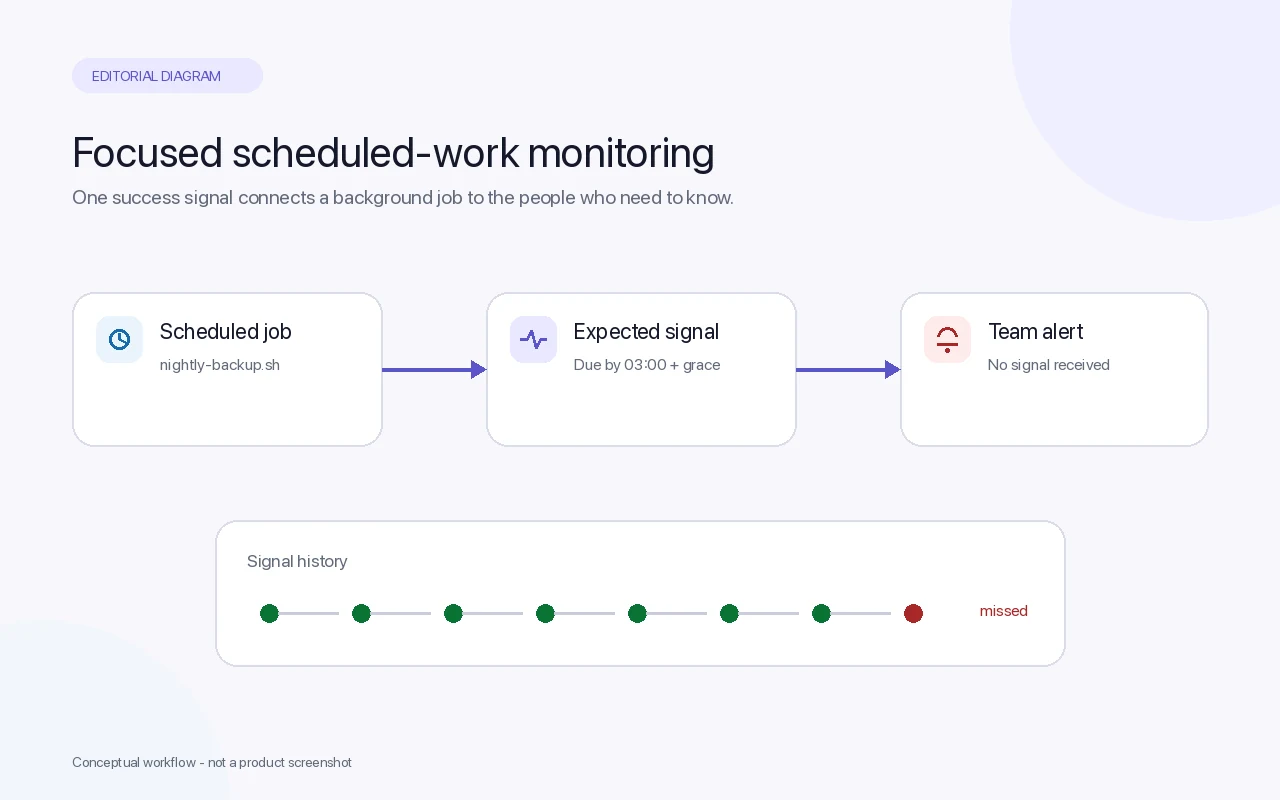
Watchgoose uses a simple heartbeat model. Your scheduled task sends a signal after it finishes. If that signal does not arrive on time, Watchgoose alerts you. This catches the failure that normal uptime checks miss: the server is online, but the work never happened.
That distinction matters for nightly backups, invoice exports, cleanup scripts, queue workers, and scheduled reports. A green server does not prove that any of those jobs ran. Watchgoose asks the better question: is anything late, down, or silent?
The Free plan includes 10 checks with no credit card requirement. That is enough to cover a handful of high-value tasks, such as the database backup, billing sync, and daily report. You can add more checks as the list grows.
Notifications can go through email, Slack, and other channels. That gives you a choice between a quiet inbox alert for a low-risk job and a team-channel alert for a task that needs quick attention. The setup stays focused, so you do not need to build a custom alert pipeline first.
Watchgoose is also AI-ready. Its hosted Model Context Protocol (MCP) server gives supported AI clients access to approved, project-scoped tools, with read-only access selected by default. Official Watchgoose plugins are available for Claude and Codex: find Watchgoose in Claude's connector directory and in ChatGPT's plugins directory for GPT and Codex. The server is also listed in the official MCP Registry, and the watchgoose-mcp package is available on npm.
Its Open Source support program extends that practical focus. Qualifying Open Source projects and nonprofits can receive a paid plan at no charge, matched to their needs. Watchgoose also pledges 5% of profit to Open Source projects, so paid subscriptions help support the ecosystem they depend on.
Watchgoose also fits freelancers and Open Source maintainers. You can monitor a personal project or public service with the same basic pattern used by a small engineering team. There is no server agent to maintain, and no dashboard maze to learn before your first check works.
The tradeoff is scope. Watchgoose is built around scheduled work and success signals. If you need deep log search, traces, Kubernetes resource views, or a full incident platform, a broader tool may fit better. For most small teams, that narrower focus is the point.
Start with the two jobs that would cause the most trouble if they went silent. The cron job monitoring documentation explains the signal pattern and alert setup.
2. Healthchecks.io: A simple heartbeat monitor with a generous no-cost tier
Healthchecks.io is a heartbeat monitor for developers and small teams that want a simple way to detect missed cron runs. It works well when your job can send an HTTP request after a successful run.
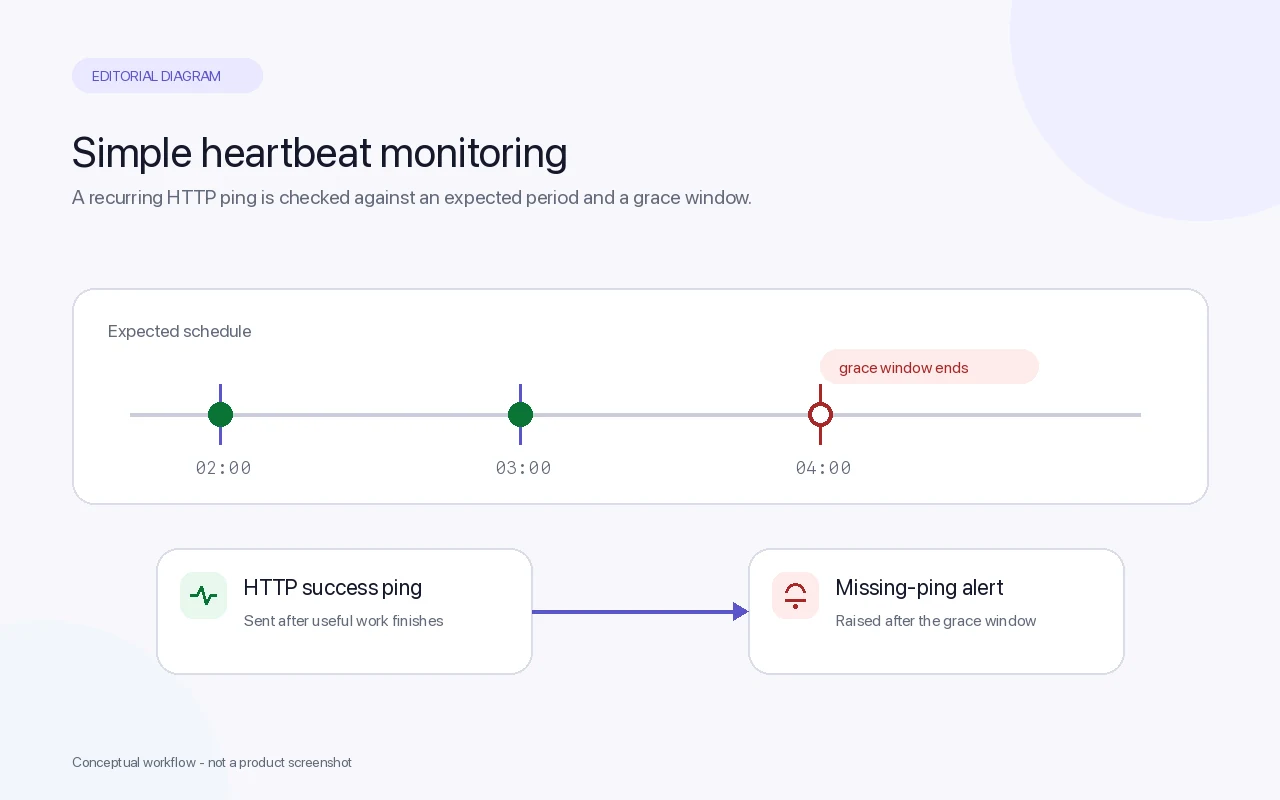
The setup is easy to understand. You create a check, copy its ping URL, and add a curl or wget call to the cron command or script. When the job completes, the ping tells the service that the run succeeded. If the ping does not arrive within the expected window, the service sends an alert.
That grace window is useful for jobs with uneven run times. Imagine a backup that starts at 2:00 but may take 20 minutes. You do not want an alert at 2:01 just because the task is still working. A grace period lets the job finish before the monitor treats the missing signal as a failure.
Healthchecks.io has 20 free checks on its hosted service with no time limit. It also has a simple web interface and a self-hosted Open Source option. That makes it attractive to developers who want control over deployment or who already run their own small services.
The service can send alerts through email, webhooks, chat tools, SMS, and incident-management systems. You can also set repeated email reports while a job remains down. That helps when the first alert lands during a busy part of the day and no one fixes the task right away.
The main caveat is that the heartbeat pattern depends on a correct ping. If you place the ping before the actual work, a broken script can still report success. Put the success signal after the work finishes, or use a failure signal when your setup needs one.
Timezone settings deserve care too. A job that appears consistently early or late may have a mismatch between the server timezone and the monitor schedule.
Choose it when you want a proven heartbeat pattern and a generous no-cost tier. Choose Watchgoose instead when you prefer a small-team workflow centered on scheduled jobs, with a straightforward path to multi-channel alerts.
3. Cronitor: Schedule-aware monitoring for complex cron workloads
Cronitor is a dedicated job monitor for teams with more complex schedules. It suits developers who need schedule-aware alerts, duration tracking, and more detail than a basic missed-ping check.
Cronitor can parse cron expressions and import crontab entries. That saves time when a server already has a long list of scheduled commands. Instead of building every check by hand, you can start with the schedule that already exists.
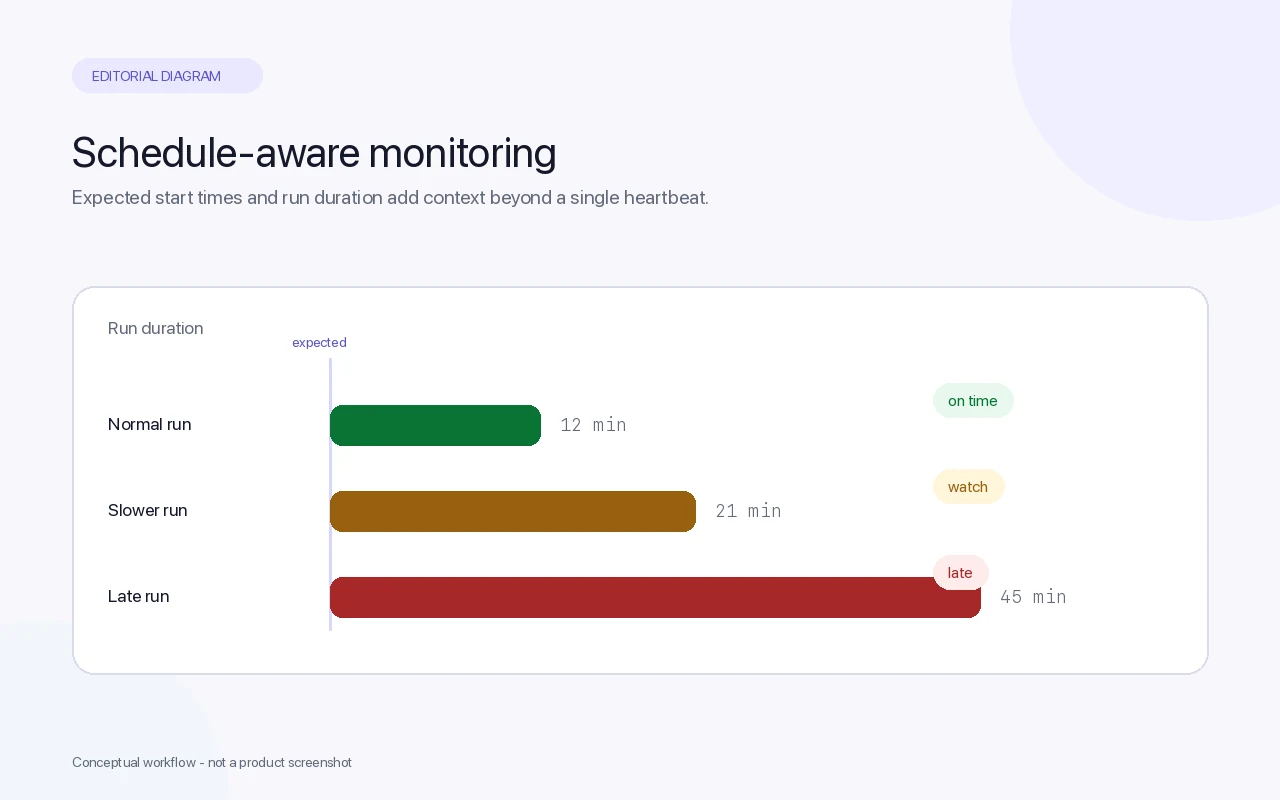
Its schedule-aware approach helps with jobs that run at different times or have changing intervals. The monitor can watch for timing anomalies, classify exit codes, and track how long a job takes. That gives you more context when a task technically runs but takes twice as long as normal.
Think about a monthly report that usually takes 12 minutes. A simple heartbeat can tell you whether it finished. Duration tracking can also show that the task now takes 45 minutes, which may point to a data-growth problem before the job starts missing its next window.
Cronitor also supports HTTP pings, language SDKs, and a Kubernetes agent for teams that need to watch jobs in that environment. Its focus remains the job itself, rather than the full health of every host and service around it.
That focus is useful, but it can be more than a small team needs. If you only have a few daily jobs, schedule parsing and anomaly views may add detail without solving a new problem. The no-cost tier includes 5 monitors, so teams with many jobs need to review the paid cost before they migrate.
Cronitor is a better fit when timing itself is part of the risk. A late data load can be as harmful as a failed one, especially when another job starts soon after it. For simple scheduled tasks, Watchgoose keeps the setup lighter. The Cronitor alternative comparison covers the main tradeoffs.
4. Hyperping: Cron monitoring with on-call and status page features
Hyperping combines cron and heartbeat checks with on-call scheduling, escalation policies, voice alerts, uptime checks, and status pages. It fits growing SaaS teams that need scheduled-job alerts as part of a wider customer-facing monitoring setup.
Its no-cost tier includes 20 monitors. That gives a small team room to cover scheduled tasks alongside a few websites or service endpoints. The broader monitor mix can be useful when the same people own both internal jobs and the public product.
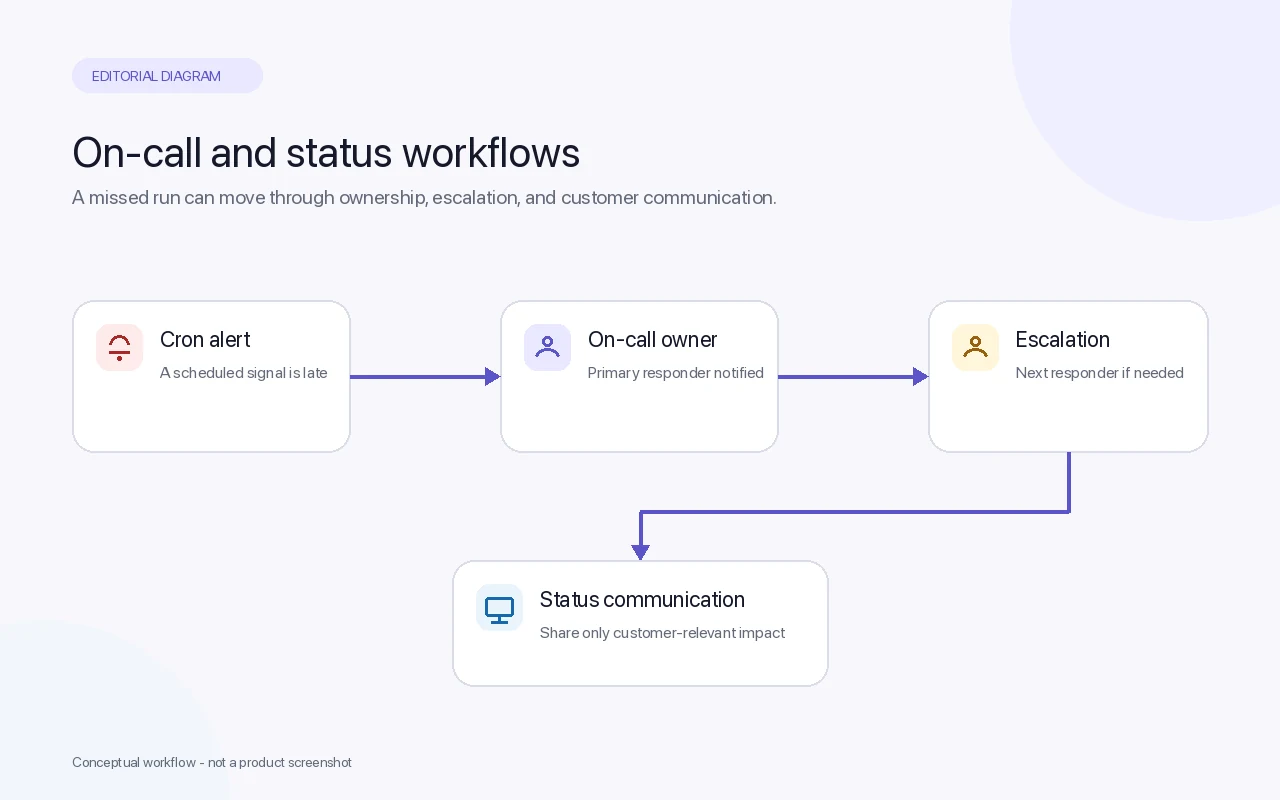
On-call tools change the response path. An email says a job failed. An on-call schedule says who owns the alert now. An escalation policy can move the alert to another person if the first responder does not acknowledge it. Voice-call alerts add another route for incidents that cannot wait until morning.
Status pages add a separate benefit for teams that need to share service health with customers. A failed background job does not always belong on a public page, but a related service outage may. Keeping the status workflow near the alert workflow can reduce tool switching.
The cost is added scope. A team that only needs five cron checks may not need status pages or escalation rules. More controls also mean more setup decisions, such as deciding which jobs wake someone up and which ones can wait for a morning review.
Hyperping is worth a look when on-call ownership is the problem, not only missed runs. For a small team that wants the lowest-maintenance route to cron alerts, Watchgoose is the cleaner starting point.
5. Better Stack: Monitoring, logs, and incident response in one platform
Better Stack brings heartbeat checks into a wider system for logs, incidents, on-call schedules, uptime monitoring, and status pages. It suits teams that want to move from a failed-job alert to related log data without changing tools.
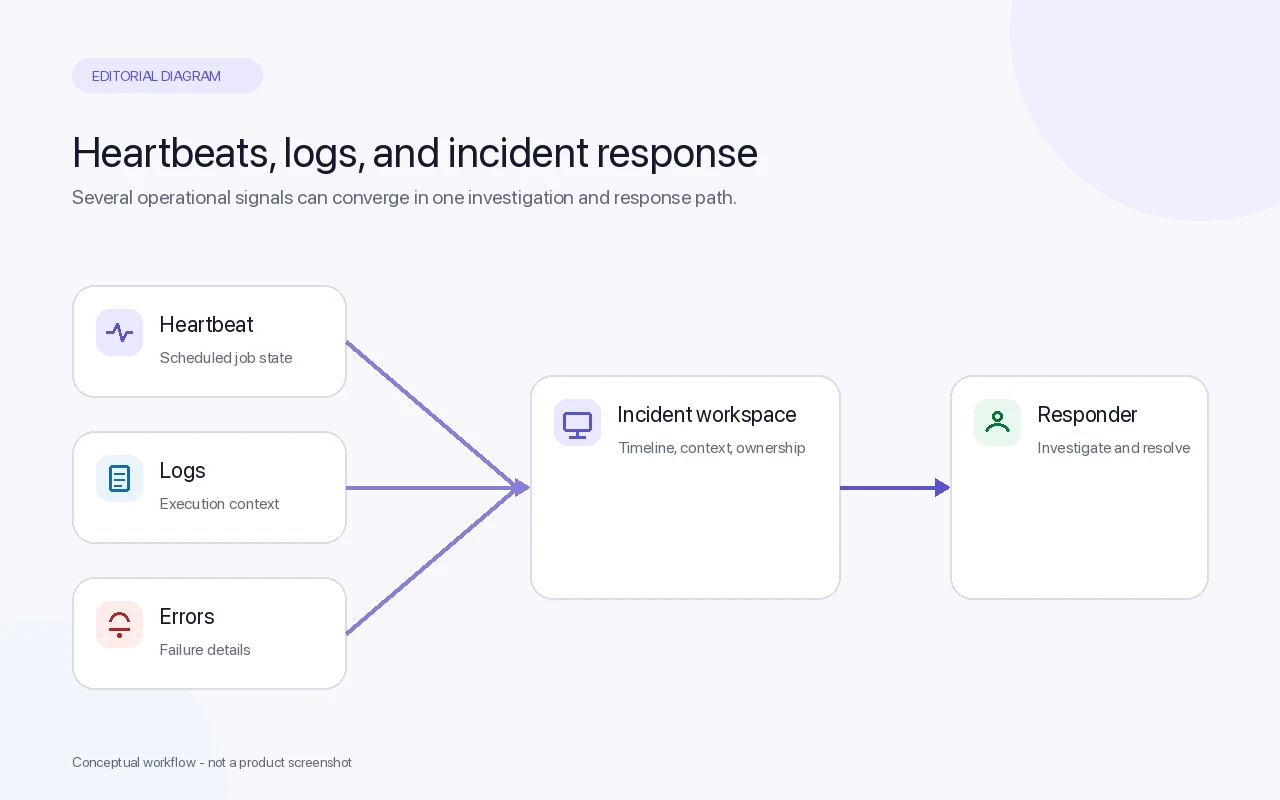
Its heartbeat checks use a unique URL for each scheduled task. The task calls that URL when it succeeds. A missing request inside the expected period and grace window can open an incident for the assigned on-call team.
The log connection can shorten diagnosis. Suppose a nightly import fails. A basic monitor tells you the import stopped. A wider monitoring platform may also show the error output, recent incidents, and the person currently on call. That can save a trip through several dashboards.
Better Stack also supports failure reporting through a fail URL. A script can report a failed state directly instead of waiting for the monitor to infer failure from silence. Teams can include output or exit information when sending the status.
The platform has a no-cost tier, but the right plan depends on how much monitoring and incident work you bring into it. Small teams should check the cost of logs, seats, retention, and extra monitors rather than judging the heartbeat feature alone.
There is also a learning curve. If your only need is to know whether a backup ran, a full incident platform may feel like too much. If your team already needs log search and on-call response, the extra scope can be useful instead of wasteful.
Pick Better Stack when job alerts belong inside a broader monitoring stack. Pick Watchgoose when you want to protect a small set of scheduled tasks without adopting a larger operational system.
6. UptimeRobot: A familiar choice for freelancers and small teams
UptimeRobot is a broad uptime monitor with heartbeat monitoring, HTTP checks, ping checks, SSL checks, DNS checks, status pages, and voice-call alerts. It suits freelancers and small teams that also monitor websites and network endpoints.
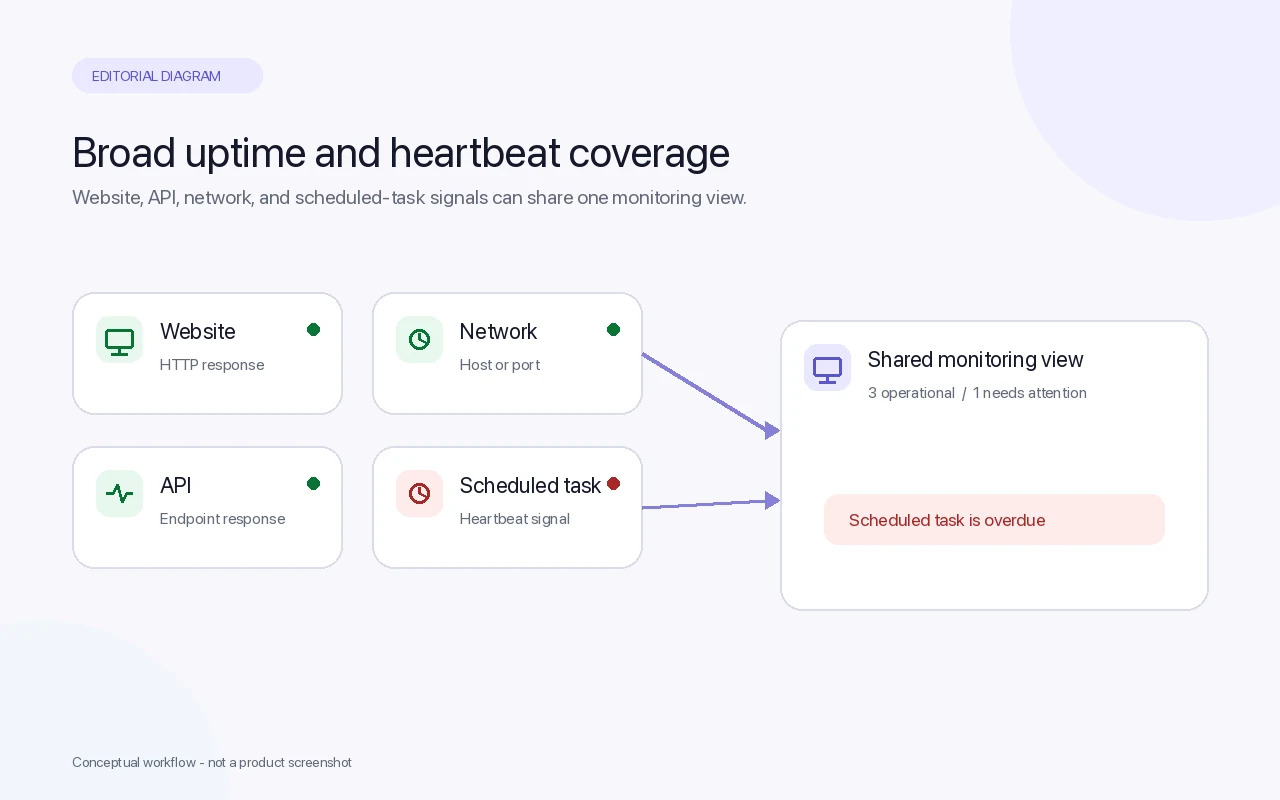
Its no-cost tier covers 50 monitors, the largest stated allowance among the options in this shortlist. That number looks attractive when you have many endpoints to watch. A freelancer managing several client sites may value the ability to keep website checks and scheduled-task checks in one account.
The catch is focus. UptimeRobot is built around broad uptime monitoring. It does not provide the same dedicated cron parsing and schedule-aware job analysis as Cronitor. If your main concern is whether a backup script completed, the extra HTTP and SSL features may add noise.
It can still work with a heartbeat pattern. Your task sends a signal when it finishes, and the monitor alerts when the signal goes missing. That is enough for many simple jobs, especially when a team already uses the service for public websites.
Voice-call alerts can help with urgent failures. But do not make every missed cleanup task a phone call. Set alert severity by job. A failed billing task may need immediate action, while a delayed thumbnail cleanup can wait for the next workday.
UptimeRobot is a sensible choice when monitor count matters more than cron-specific detail. The counterpoint is important: the largest no-cost tier is not automatically the best fit. Watchgoose's smaller no-cost tier is more aligned with teams that need focused scheduled-job monitoring rather than a general uptime suite.
Comparison table: Which cron monitoring tool fits your team?
The best cron monitoring for a small team depends on the failure you need to catch and the system you already use. A large free allowance can help, but it does not remove setup work or alert noise.
Scroll horizontally to compare all columns.
| Tool | Best fit | Free allowance | Strong point | Watch out for |
|---|---|---|---|---|
| Watchgoose | Small teams with scheduled jobs | 10 checks | Focused cron, backup, queue, and script monitoring | Less suited to full logs and traces |
| Healthchecks.io | Simple heartbeat checks | 20 checks | Clear ping model and self-hosted option | Needs careful ping placement |
| Cronitor | Complex cron schedules | 5 monitors | Schedule parsing and duration tracking | More detail than basic teams may need |
| Hyperping | Teams needing on-call and status pages | 20 monitors | Escalation and voice-alert features | Broader setup than simple cron monitoring |
| Better Stack | Monitoring plus logs and incidents | No-cost tier available | Job alerts beside logs and incident response | Plan costs depend on wider usage |
| UptimeRobot | Freelancers with many endpoints | 50 monitors | Broad uptime coverage | Less cron-specific control |
For a small team starting from scratch, Watchgoose is the most direct fit. Healthchecks.io is a strong alternative for a basic heartbeat model. Move toward Cronitor when schedule detail matters. Choose a broader platform when uptime, logs, status pages, or on-call work already sit on the same priority list.
Free-tier details were reviewed for this 2026 guide but can change. Check each provider's current plan and feature pages before migrating production monitoring.
What to look for in cron job monitoring for a small team
Start with the jobs that run without a person watching them. Background work often handles backups, reports, cleanup, data checks, or long-running processing. Schedule-driven tasks differ from event-driven tasks, which helps you decide what should send a recurring success signal.
A good monitor should answer four questions quickly:
- Did the job run?
- Did it finish successfully?
- Was it late?
- Who will act if it fails?
The signal should come after the useful work finishes. A ping at the start of a script only proves that the script began. For a backup, the signal belongs after the backup result is known. For a queue worker, it may belong after the batch has been processed.
Grace windows matter too. Set one longer than the normal run time, with room for ordinary variation. A tight window creates false alarms. A very long window delays a useful alert. Test the setting by forcing a safe failure before you trust it with a production backup.
Count maintenance work as part of the price. Self-hosted or observability-heavy options can be free in license terms while still needing engineering time, infrastructure, alert rules, and upgrades. Small teams should prefer the tool that removes work they do not want to own.
Finally, check alert paths. Email may be enough for a low-risk report. Slack can work for shared review. A high-risk billing or backup failure may need an escalation path. Review the Watchgoose notification documentation while setting up your first checks.
One more rule: monitor the outcome, not only the process. A command that exits successfully can still produce an empty file or stale result. Where possible, add a simple check for the expected output. That extra test catches jobs that technically ran but failed to do their real work.
Frequently asked questions
What is the best cron job monitoring for small teams?
Watchgoose is the best starting point for small teams that need focused monitoring for cron jobs, backups, queues, or scripts. It has a no-cost allowance, no infrastructure to install, and alerts for missed signals or reported failures. Healthchecks.io is a good alternative for a simple heartbeat setup, while broader platforms fit teams with wider monitoring needs.
How does cron job monitoring work?
Cron job monitoring usually works by sending a heartbeat after a scheduled task succeeds. The monitor expects that signal at a set time. If it does not arrive within the grace window, the monitor sends an alert. This catches silent failures even when the server itself remains online.
Is a free cron monitor enough for a small team?
A free cron monitor is often enough when you have a short list of high-value jobs. Start with backups, billing tasks, data syncs, and customer reports. Check the alert channels and limits before relying on it. A focused allowance can be more useful than many generic monitors if the tool matches your schedule.
Should I use uptime monitoring or cron monitoring?
Use cron monitoring for scheduled work and uptime monitoring for services that should respond to requests. A website can be online while its nightly export fails, so uptime alone cannot cover both risks. Teams that need both may choose a broader platform, but small teams often get clearer alerts by keeping the job check focused.
Where should I place the success ping in a cron script?
Place the success ping after the task has completed and its result is known. If you put it at the start, a script can report success before the backup, export, or sync fails. For important jobs, also check that the expected output exists and contains usable data before sending the final signal.
Conclusion
Choose Watchgoose if your team needs a focused, low-maintenance way to catch missed cron jobs and failed scheduled tasks. Start with one backup and one business-critical job, then test the alert path by sending a safe failure signal. If your needs later grow into logs, on-call schedules, or full infrastructure views, you can reassess with a clear record of what the simple monitor already covers.